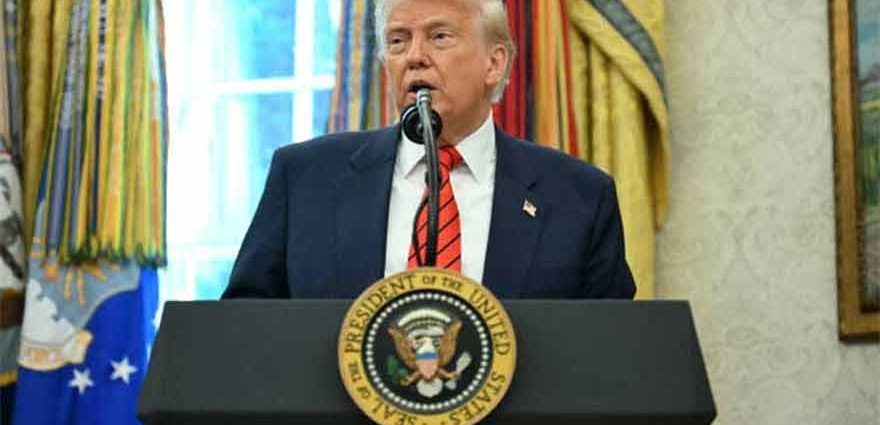
The deal will be formally inked in Switzerland on Friday.
EVIAN-LES-BAINS, France (Reuters) – Doubts surrounded the US-Iran temporary agreement to halt the Middle East conflict, with fears that shipping and oil exports might take weeks to recover, despite US President Donald Trump’s statement on Tuesday that the document will be made public shortly.
The temporary agreement would prolong a precarious truce established in April for another 60 days and reopen the Strait of Hormuz, which Iran has essentially closed since the US and Israel attacked Iran in February.
According to Trump, the deal’s wording clearly indicates that Tehran will not have a nuclear weapon, and the complete accord will be made public in a formal setting in a few days.
Speaking at the G7 summit in France, Trump stated that he supported bringing the Iran agreement to Congress for review, as requested by certain Republican senators.
Negotiators will handle thorny problems such as the future of Iran’s nuclear programme during the next round of negotiations, which, according to Iranian Foreign Minister Abbas Araqchi, will begin in Switzerland on Friday following the formal signing of the framework agreement.
Two additional points mentioned by Trump and Israeli Prime Minister Benjamin Netanyahu to justify the conflict – halting Iran’s funding for regional armed proxies and limiting its missile development – are not expected to be on the table for those conversations.
“Iran wants to get it done,” Trump told reporters on the next round of negotiations with Iran. “They have to get back to business, and the relationship is now normalized, so I think it’s going to go pretty quickly.” He previously called the pact as “a wall to a nuclear weapon” for Iran.
Vice President JD Vance and Iran’s main negotiator, Mohammad Baqer Qalibaf, are set to attend Friday’s ceremonial signing.
Related posts:
 Trump claims the US has more time to capture the Strait of Hormuz.
 Qatar’s PM confirms a ceasefire and hostage agreement between Israel and Hamas in Gaza.
 Trump promises a ‘golden period’ after being inaugurated in as US president.
 Iran is willing to resume nuclear discussions with the USA if confidence is established : President Pezeshkian.
 Trump touts the truce as his ‘greater achievement’ and promises to promote trade with Pakistan.
 Bangladesh’s BNP wins historic elections.
 France’s political crisis escalates as PM Michel Barnier’s government loses the trust vote.
 Donald Trump states he ‘took bullet for democracy’
 In a conversation with Trump, the Saudi crown prince promises massive trade and investment gains.
 Trump invites Prime Minister Shehbaz to join Gaza’s ‘Board of Peace,’ claims FO