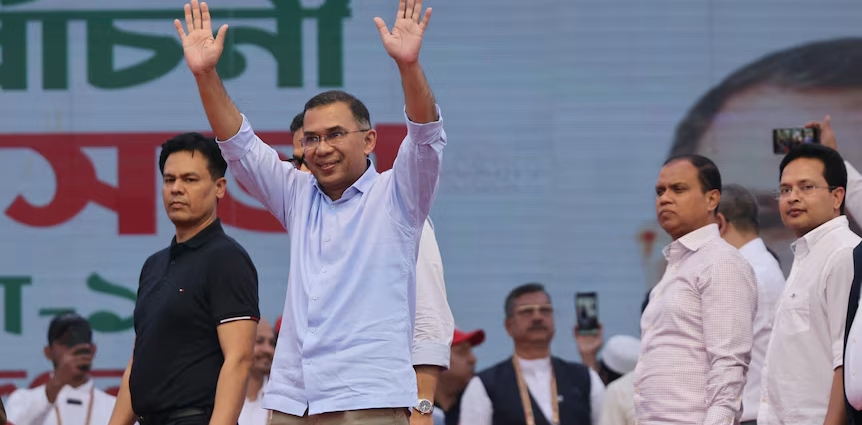
The Bangladesh Nationalist Party comfortably won 185 seats in Bangladesh’s 300-member parliament, surpassing the halfway point for a simple majority.
According to local TV stations, the Bangladesh Nationalist Party has won a historic parliamentary election, winning a resounding mandate in a key vote that is anticipated to restore political stability to the South Asian country.
Tarique Rahman, the 60-year-old son of former Prime Minister Khaleda Zia and former President Ziaur Rahman, leads the BNP as a prominent candidate for Prime Minister.
The legislative election conducted yesterday was Bangladesh’s first since the 2024 gen Z-led revolt that deposed long-time Prime Minister Sheikh Hasina, who went to live in exile in New Delhi, India.
A clear decision was vital for calm in the Muslim-majority country of 175 million after months of violent anti-Hasina riots interrupted ordinary life and hurt important sectors, particularly the clothing sector, in the world’s second-largest garment exporter.
According to local television stations, the BNP won a landslide two-thirds of the 300 seats in the “Jatiya Sangsad” or House of the Nation.
Shafiqur Rahman, the president of the Islamist Jamaat-e-Islami party, admitted defeat, with his party’s alliance winning only 68 seats.
The National Citizen Party (NCP), formed by youth activists who helped topple Hasina and was a member of the Jamaat-led alliance, won just five of the 30 seats it contested.
Along with the election, preliminary results from a referendum revealed that people voted in favor of amending the constitution to protect it from future authoritarian control.
The “July Charter” is a collection of reforms developed following the 2024 revolt to promote good government, democracy, and social fairness.
In contrast to Sheikh Hasina, who was perceived as being in line with New Delhi, BNP leader Mr. Rahman has promised to rebalance Bangladesh’s international alliances in order to draw in investment without binding the nation too tightly to any one entity.
He has also emphasized increasing financial assistance for low-income families, encouraging businesses like toys and leather products to reduce dependency on garment exports, and limiting prime ministers to two terms of ten years each to discourage dictatorial inclinations.
Related posts:
 Khaleda Zia, Bangladesh’s first female prime minister, died at age 80.
 In accordance with SC directives, the ECP releases a schedule for the 2024 general elections.
Gohar claims that conspirators are attempting to steal the PTI’s election emblem.
Imran Khan worries about the PTI’s lack of a level playing field.
PML-N’s Malik Ahmad Khan chosen PA speaker, Malik Channer as deputy speaker.
In accordance with SC directives, the ECP releases a schedule for the 2024 general elections.
Gohar claims that conspirators are attempting to steal the PTI’s election emblem.
Imran Khan worries about the PTI’s lack of a level playing field.
PML-N’s Malik Ahmad Khan chosen PA speaker, Malik Channer as deputy speaker.
 France’s political crisis escalates as PM Michel Barnier’s government loses the trust vote.
 Qatar’s PM confirms a ceasefire and hostage agreement between Israel and Hamas in Gaza.
 Trump promises a ‘golden period’ after being inaugurated in as US president.
 24 former lawmakers are disqualified by ECP for failing to disclose their assets.
 The opposition coalition indicates a readiness to accept the PM’s offer to speak.