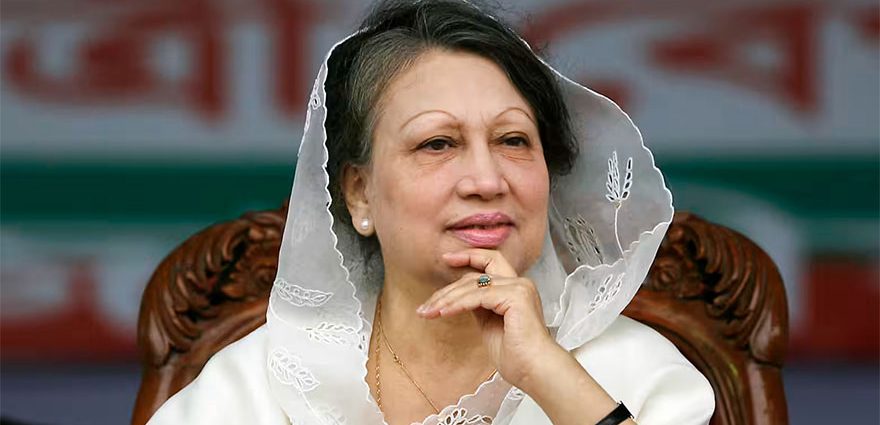
Khaleda Zia, who became Bangladesh’s first female prime minister in 1991 and developed a fierce rivalry with Sheikh Hasina during decades of power struggles, died on Tuesday after a protracted illness. She was eighty.
Her opposition Bangladesh Nationalist Party (BNP) said she died after a protracted illness. Her physicians diagnosed her with severe liver cirrhosis, arthritis, diabetes, as well as chest and heart issues.
She traveled to London for medical treatment in early 2025 and stayed for four months before returning home.
Despite being out of power since 2006 and spending several years in jail or under house arrest, Khaleda and her centre-right BNP maintained widespread popularity.
The BNP is viewed as the frontrunner in the parliamentary election scheduled for February. Her son and interim party chairman, Tarique Rahman, 60, returned to the nation this week after nearly 17 years in self-exile and is largely seen as a strong candidate for prime minister.
Bangladesh has been ruled by an interim administration led by Muhammad Yunus, the Nobel peace winner and microfinance pioneer, since August 2024, when a student-led rebellion forced Hasina’s resignation.
In November, Hasina was condemned to death in absentia for her violent crackdown on student protests.
Khaleda Zia, known only by her first name, was characterized as quiet and dedicated to raising her two kids until her husband, military commander and then-President Ziaur Rahman, was slain in an attempted army coup in 1981.
Three years later, she became the head of the BNP, which her husband had formed, and swore to carry out his goal of “liberating Bangladesh from poverty and economic backwardness”.
She collaborated with Hasina, the daughter of Bangladesh’s founding father and the leader of the Awami League party, to spearhead a democratic revolt that deposed military dictator Hossain Mohammad Ershad in 1990.
Related posts:
 Prime Minister Modi has announced that India would host the Quad Summit next year.
After an attempted insurrection, the Russian PM exhorts the populace to support Putin.
In accordance with SC directives, the ECP releases a schedule for the 2024 general elections.
Gohar claims that conspirators are attempting to steal the PTI’s election emblem.
Prime Minister Modi has announced that India would host the Quad Summit next year.
After an attempted insurrection, the Russian PM exhorts the populace to support Putin.
In accordance with SC directives, the ECP releases a schedule for the 2024 general elections.
Gohar claims that conspirators are attempting to steal the PTI’s election emblem.
 France’s political crisis escalates as PM Michel Barnier’s government loses the trust vote.
 Trump touts the truce as his ‘greater achievement’ and promises to promote trade with Pakistan.
 The opposition coalition indicates a readiness to accept the PM’s offer to speak.
The election in Kuwait doesn’t significantly alter the legislature or provide any promise of ending years of impasse.
Indian official mocks Obama’s remark on defending Muslims
PML-N’s Malik Ahmad Khan chosen PA speaker, Malik Channer as deputy speaker.
The opposition coalition indicates a readiness to accept the PM’s offer to speak.
The election in Kuwait doesn’t significantly alter the legislature or provide any promise of ending years of impasse.
Indian official mocks Obama’s remark on defending Muslims
PML-N’s Malik Ahmad Khan chosen PA speaker, Malik Channer as deputy speaker.